
.png)
Colored Rosemont, Historic marker honors legacy of resilience.
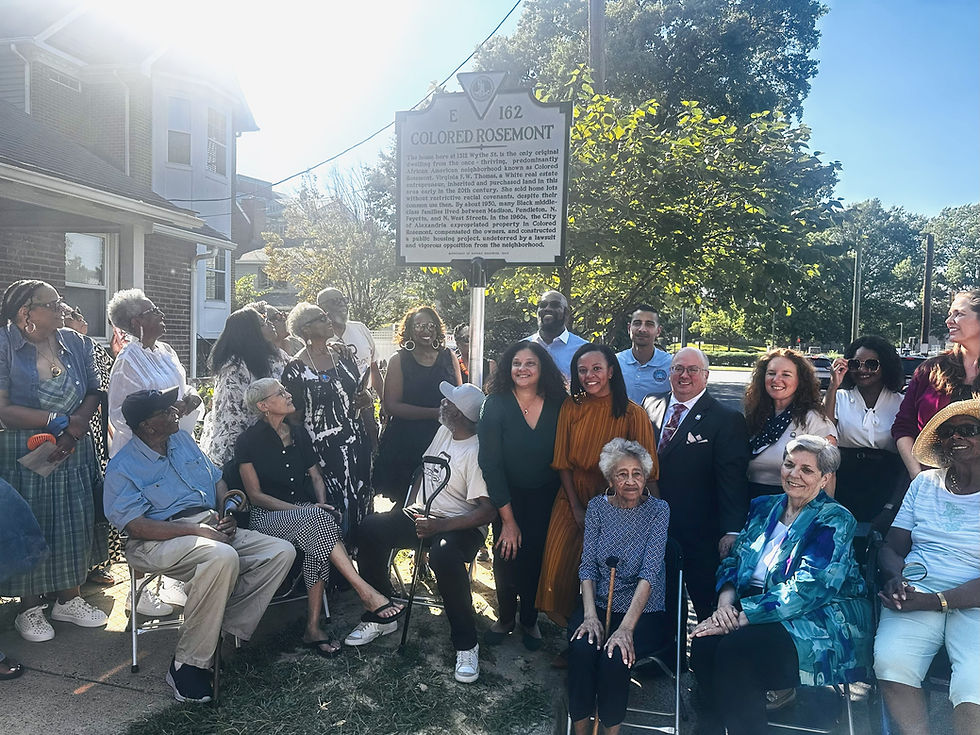
Nestled in the Parker-Gray Historic District of Alexandria, the neighborhood historically known as Colored Rosemont stands as a testament to African American perseverance. That legacy was honored Sept. 13 as the Office of Historic Alexandria unveiled a new state historic marker recognizing the significance the community played in the fight against segregation.
Mayor Alyia Gasking was on hand for the unveiling of the marker, which is located at the corner of Wythe and West streets. In her remarks, she said aloud the names of the families that once resided there.
“I take the time to say each of their names because their names and their legacies are part of why we are joined here today,” Gaskins said. “We're joined here to celebrate and recognize their foresight and their perseverance but also the work that they put in not just to build their lives but to make sure that we built a community, a neighborhood where neighbors took care of neighbors.”
Established in 1926, Colored Rosemont emerged when Virginia F.W. Thomas, a white real estate broker, began selling plots of land to African American families — an act of defiance against the racially restrictive covenants common at the time. Bounded by Pendleton, Fayette, Madison, and North West Streets, the neighborhood offered a rare opportunity for Black homeownership in a city where segregation severely limited housing options.
As the community flourished, families such as the Berry, Jackson, McCray, and Watsons built homes, raised children, and cultivated a vibrant neighborhood life. Though the name Colored Rosemont was never officially recorded on maps, it was widely used to distinguish the area from the adjacent white neighborhood of Rosemont, from which Black residents were excluded.
By the mid-20th century, however, the neighborhood faced challenges of discriminatory housing policies. Eminent domain led to the dismantling of Colored Rosemont, with many families displaced to make way for public housing projects.
“We are beyond thrilled for this sign dedication, which honors the important legacy of Colored Rosemont,” said Gretchen Bulova, Director, Office of Historic Alexandria. “At the same time, this sign is a somber reminder of how racist housing policies and practices led to the displacement of a thriving African American community.”
The ceremony brought together descendants, city officials, and historians, highlighting the importance of preserving the city’s African American heritage.
“This is my heritage,” said Angela Armwood, who attended the event. “It is where I grew up as a little girl. I am glad that we are finally being recognized as the Colored Rosemont community.”
Said Audrey Davis, Director of the Office of Historic Alexandria’s African American History Division, “The installation of this historic marker is only the beginning as we continue to conduct and publish further research about Colored Rosemont and the displacement of its residents.”


